
“It’s Like a Wheel … An Unending Promise to Our Neighbors When We’re Gone”

Duck Pond Owners Expand Easement with Land Purchase
When Marti Bryant first visited Clarke County with a fellow equestrian in 1982 – the two had seen a mention of the Blue Ridge Hunt in a magazine – little did she know the trip was the beginning of a life-changing adventure.
Today, Marti and her husband, David, own Duck Pond, the sweet homestead off Old Winchester Road in Boyce. The original portion of the house was built in 1870. Additions subsequently were made, including mirroring porches on each side of the house, with identical furnishings – complete with binoculars to birdwatch – and breathtaking views of rolling terrain, magnificent trees, visiting fauna.
After many treks to the area, one day when the time came to pack up and head back to Baton Rouge, where David had spent his entire life and Marti had lived for four decades, David recalls their moment of revelation: “We looked at each other and said, you know, we want to stay here.”
They’ve been settled at Duck Pond for seven years now.
Recently, the Bryants had the opportunity to purchase approximately 60 acres from a neighboring property owner. They jumped at the chance, adding to their existing 40-acre parcel. The initial property had been protected by an easement held by the Virginia Outdoors Foundation since 1976. The Bryants then approached the Clarke County Conservation Easement Authority about merging the properties into a larger easement.
“We worked on transferring the Bryants’ Virginia Outdoors Foundation easement to the Clarke County Conservation Easement Authority as the holder and also placing the remainder of the adjacent land still owned by the seller, about 28 acres, into easement,” explains Lorien Lemmon, the Easement Authority’s conservation planner. “It was a lot of collaboration between two neighbors who ultimately wanted to see their land protected.”
David was pleased with the outcome: “We wanted the same thing the Easement Authority wanted. I don’t think the easement would have happened if we didn’t. We were all very flexible.”
“Clarke County has been so careful about conservation,” David adds. “Easement is good for the landowner and good for the county. How would you like to wake up and have a development next door? I didn’t do an easement to get a tax break. I did it because it’s good for the community.”
The sprawling landscape offers the Bryants many joys. For Marti, she frequently goes horseback riding through the fields on the carefully carved trails, often traversing from Duck Pond to the homes of friends who live on Pyletown Road. For David, he enjoys trail shaping with his tractor and keeping an eye on the abundant wildlife. During this summer’s drought, he even dug a small pooling area near the house, keeping it filled with water from the hose to make sure critters always found a place to drink.
On a recent weekday in August, David and Marti were planning a large family get-together for the upcoming weekend – with several of the six grandkids, ages 10 to 24, promising to bring motor bikes to ride the miles of trails.
“We’re having so much fun,” Marti smiles. “Every single day, we say we’re so glad we moved here.”
“It’s like a wheel,” David adds philosophically. “You think of all the tears, the joys, the laughter, the fears that happen on a property over the years. Through our easement, we’re making an unending promise to our neighbors that when we’re gone, this property will always remain very similar to the way it is today.”
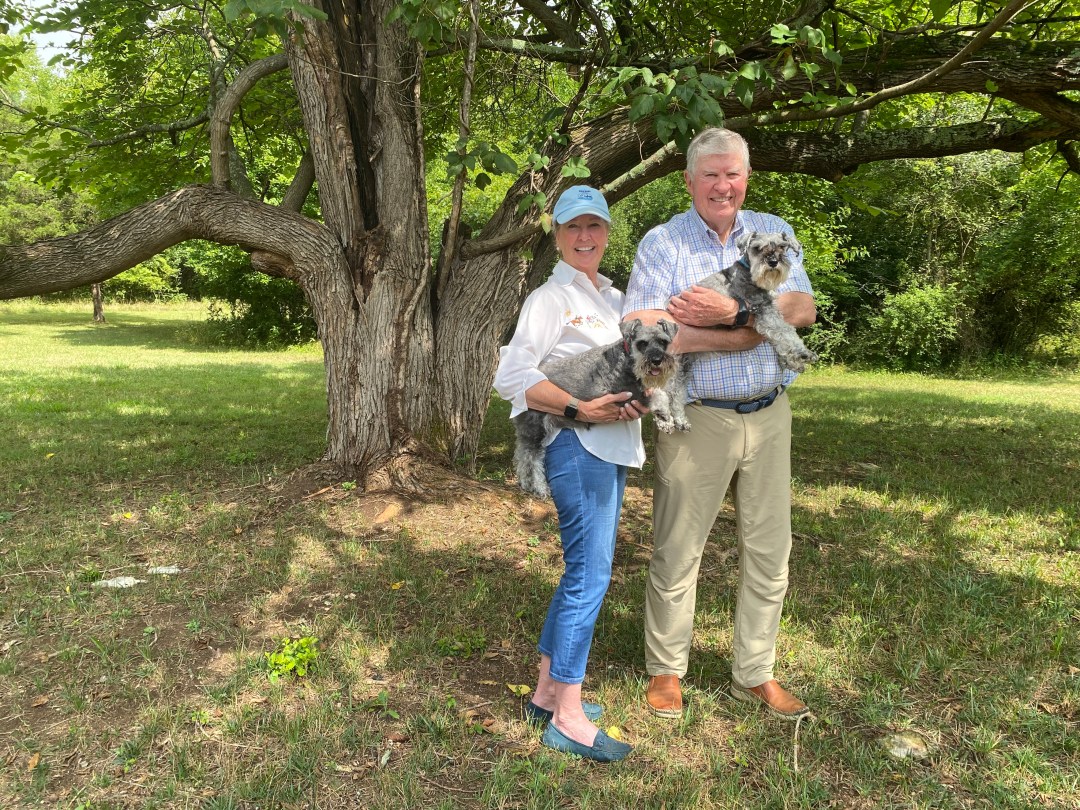
Photo above: At Duck Pond, Marti and David Bryant enjoy the many trails with their trusty companions Millie and Hilde.
Beloved Clarke County Fairgrounds Now Permanently Protected by Easement
It’s safe to say most Clarke County residents have spent time at the Clarke County Fairgrounds – whether enjoying the annual county fair with their families, competing or spectating at livestock and equine shows, celebrating holiday fireworks, marveling at antique steam engines, or shopping markets for vintage ware.
Now, fairgoers will be able to share their memorable experiences with new generations. In fact, many new generations.
As of October 10, the more than 47 acres of fairgrounds, owned by the Clarke County Ruritans Club, were officially protected forever by an open-space easement. Old Dominion Land Conservancy, the Purcellville-based easement holder, officially recorded the easement.
Brad Broy, the Ruritan Club’s president for the last four years, explains the club has owned the fairgrounds since 1951.
According to Broy, the decision to place the property in easement actually began in 2020 as part of the Ruritan Club’s transition from a 501(c)4 to a 501(c)3 organization. Working with an attorney, the group was reviewing a checklist of items important to their new organizational structure, and that checklist included guarding the property’s value.
“We were worried,” said Broy. “We wanted to make sure this land is protected forever. And we want the property to always be the fairgrounds. In this county, it’s really all we have for so many types of events. We host everything here – the county fair, fireworks, horse shows, holiday events, markets … people can walk their dogs, do yoga, whatever. We don’t lock the gates.”
The easement process started formally in August 2023, and the Ruritans immediately agreed they would retire all the dwelling unit rights (DURs) on the property.
Brook Middleton, CPA of The Virginia Easement Exchange, guided the group through the research and decision-making. Middleton pointed out in a report to the Clarke County Conservation Easement Authority that the zoning for this property prior to the easement could have allowed for a maximum potential density of 540 housing units.
540 housing units?
Yes, that was a possibility. Broy shakes his head.
As part of the easement transaction, the Ruritan Club will earn tax credits. Broy explains the Ruritans are prudent with their finances and always thinking of the future.
“We’re hoping to put any dollars we save from the credits into property upgrades and a long-term endowment, so the fairgrounds will be secure forever,” he stresses. “The only thing we’re trying to do is protect the land for all of us.”
On March 19, 2024, the Clarke County Board of Supervisors approved and ordered into the official records a Resolution of Support for the Conservation and Protection of the Fairgrounds. The resolution cited that the “conservation and preservation of the Fairgrounds will yield significant benefits to the citizens of Clarke County by (1) preserving the unique character of the Fairgrounds as a recreational, educational, and cultural resource for County residents, (2) preventing loss of the Fairgrounds to residential development, (3) promoting Clarke County agricultural education and appreciation, (4) advocating the benefits of conservation easements, and (5) promoting Clarke County tourism and commerce.”
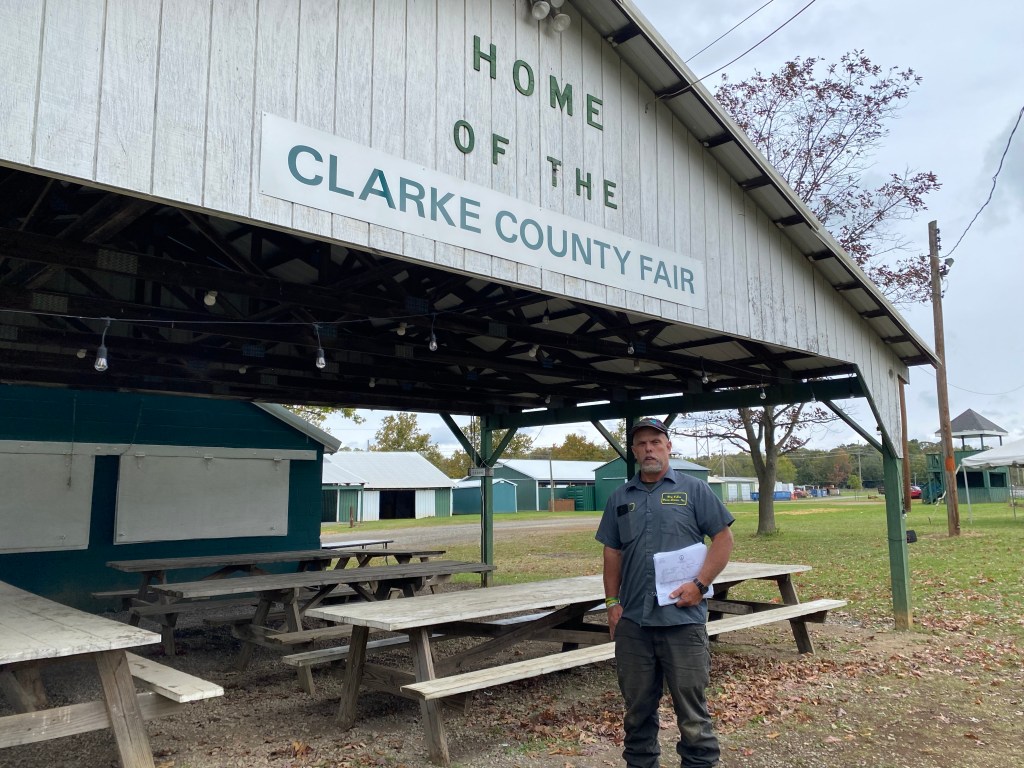
Photo above: Brad Broy at the Ruritans’ Clarke County Fairgrounds
Love of Nature Runs Full Circle with Myer Family
“I can’t even imagine three more houses here.”
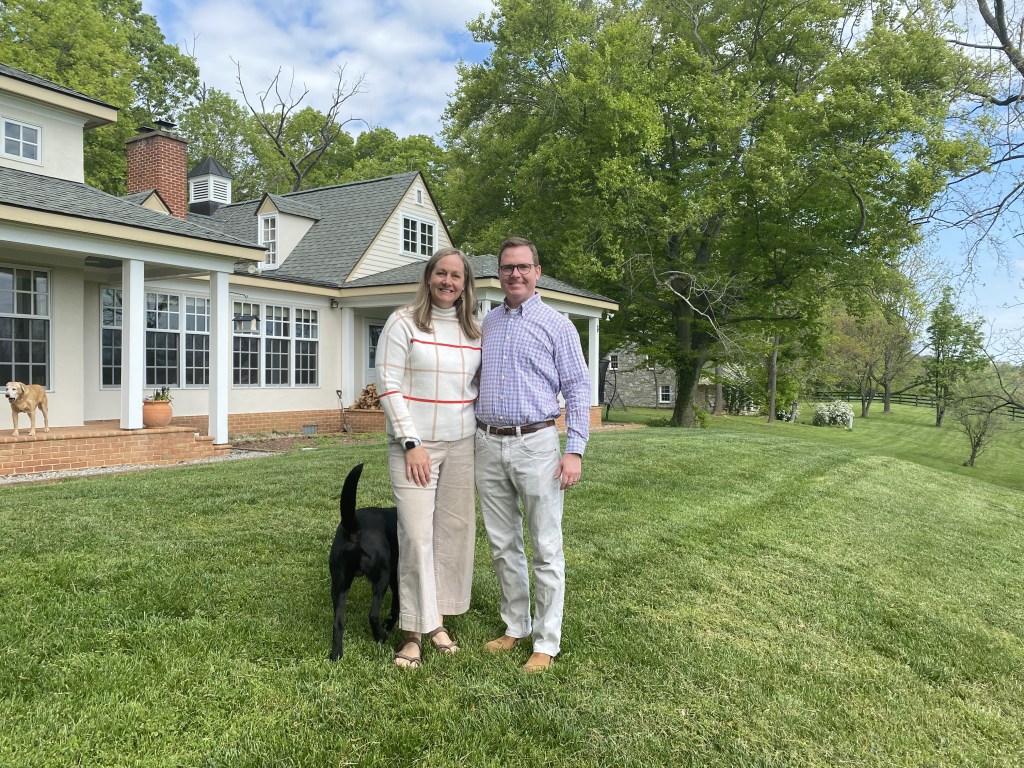
Looking out over the breathtaking panorama of the Blue Ridge Mountains behind their Boyce home, Joe and Tamara Myer beam. “It’s hard to find a better view than this,” Joe says proudly.
The Myers have owned Stubblefield Farm on Briggs Road for two years. They’ve quickly made it a comfortable home for them and their four children, as well as a small agricultural venture with an Angus cow/calf operation and several horses.
The 40.2-acre property includes the primary home, which over the years has grown around a log cabin built in 1792, now the dining room in the center of the home. The property also includes a lovely nearby guest house, The Hill House, built in 1979 but designed with a historic vibe. It’s perfect for welcoming friends and family for long weekends, say the Myers. They also occasionally host short-term renters from Airbnb.
“I can’t even imagine three more houses here,” Joe says, referencing the property’s original three additional dwelling unit rights. “It would really change the farm.”
Tamara agreed: “Even the road in front of the house would be different. There certainly would be more traffic. We knew from the beginning we wanted to maintain the farm just as it is.”
The Myers’ decision to place the land in conservation easement makes certain that is exactly what happens. As part of the easement agreement, two dwelling units were retired, leaving just one for potential future development.
Starting the easement process soon after they purchased Stubblefield was natural for the Myer family.
Joe and his four siblings grew up in Clarke County on Roseville Farm in Berryville. His late father, Eric, was a veterinarian and founded Roseville Veterinary Clinic in Boyce.
“Nature has always been part of my family’s daily routine,” Joe recalls. “Animals were part of our life. With a rural life, you’re always immersed in nature.”
Tamara laughs, “It’s who Joe is. When he’s wearing his overalls, we call him Farmer Joe.”
Indeed, they consider their farming adventures “life lessons for our children.” The couple share daughters Katherine, 19, Reagan, 17, Margaret (“Maggie”), 13, and son Eric, 10. (Katherine currently spreads the family’s love of nature as an environmental science major at Virginia Tech.)
The Myers weren’t strangers to conservation easements before they inquired about the process, given their time spent in Clarke County’s open spaces. Plus, Tamara once served as the town manager in Boyce, so she understood how easements work.
According to the Myers, the entire easement process for Stubblefield spanned from September through December 2023. “Alison (the county’s easement specialist) was straightforward about the process,” explains Joe. “While it can be quite involved, the Easement Authority was a very good resource, striking a nice balance between achieving the mission of the organization and making the transaction practical for property owners.”
“We’re happy with how it turned out, from every angle,” adds Joe. “We’re happy we did it. We still have plenty of control over the property.”
“And everybody was always on the same page,” Tamara points out.
Any advice for others considering a conservation easement? “Leverage the resources the Easement Authority offers,” Joe emphasizes. “Talk to people who have done it. Talk to people with financial expertise in this area. Get a full picture of what’s involved. To permanently change property rights is a huge deal. Weigh the pros and cons. And know there are plenty of off-ramps if you start the process and decide against it.”
Tamara suggests simply exploring the possibility of an easement is worthwhile, even if a property owner isn’t certain it will work: “Don’t be afraid to start the process. It doesn’t mean you have to follow through. The Easement Authority was clear with a timeline throughout for us. Remember, you control it.”
Photo above: Tamara and Joe Myer at their beloved Stubblefield, now protected by easement.
For Nursery Owner Tupper Dorsey, the Strength of the County’s Easement Community Makes the Difference

When Tupper Dorsey was young, around five years old, his family moved from Clarke County to Winchester. The Dorseys were in the apple business. Tupper didn’t pay much attention to production at the time, he says, but now he appreciates the perseverance and savvy it takes to work the land and grow.
“As I got older, my perspective changed,” he recalls. “If you farm, you always appreciate your land, but you look around and see all this growth. Now I say thank goodness Clarke County leaders had the foresight to implement sliding scale zoning.”
Today, all 732 acres of Dorsey’s Clarke County property are preserved by conservation easement. Between 2013 and 2016, he protected parcels ranging in size from 57 to 287 acres. Over that time, he also retired 18 dwelling unit rights, or DURs.
Moore & Dorsey Nursery was founded in 1929 by Ralph N. Dorsey, Tupper’s grandfather, and E. Blackburn Moore, a Virginia state representative for 35 years and speaker of the House of Delegates for 18 of those years.
Tupper is now president of Moore & Dorsey, based in Berryville on Sipe Hollow Lane. This spring, the business is bustling with activity. Rows of young trees stretch across the rolling landscape; some are tagged with colorful ribbons for special clientele. The firm sells all its trees wholesale, balled and burlapped and destined primarily for landscapers working east of Clarke County toward Washington, DC, says Dorsey. The inventory includes such varieties as maple, oak, cherry, elm, and dogwood, as well as turf grass and grain. “There’s increasingly a push for native materials,” Dorsey notes. “We’re even growing hackberry now.”
Given his years of working in concert with the land, Dorsey believes in the easement philosophy.
“The fear with easements is you’ll give up flexibility and property value,” he explains. “But in my mind you don’t give up the value you think you might. Look a few years down the road. With all the growth around us, the land supply is dwindling. Open space has value now and will continue to increase in value. And for people who farm, it’s also the kind of value that isn’t counted in dollars and cents. We appreciate the open space in Clarke County – it’s a beautiful place.”
Dorsey’s wife, Wendy, agrees: “This is the kind of place we want to have. And it’s not just us. Lots of people are doing this.”
The strength in numbers makes Clarke County different from other counties, says Dorsey. With 25 percent of the county’s land in easement, landowners with easements are a powerful community. “When there’s a strong group of people protecting their land with easements, like there is in Clarke County, it’s easier for people to resist the pressure of outside growth and developers,” he explains.
As for the easement application, Dorsey says, “I actually enjoyed the process. It’s a well-run system. I can’t think of anything that was a problem for us. The Easement Authority is trying to make it work for landowners.”
Not only are Tupper and Wendy Dorsey immersed in land conservation. Both their daughter and son interned during separate summers with the Easement Authority. Sophie is now a teacher, and David will soon finish college and return to the area to help manage the farm.
Ever community-minded, Moore & Dorsey Nursery recently provided trees to plant along Berryville’s bike path on West Main Street, as well as trees to serve as a buffer between Milton Valley Cemetery and the Clarke County Business Park.
Photo above: Wendy and Tupper Dorsey get ready for a day’s work at the Moore & Dorsey Nursery in Berryville.
After 40 Years of Tree Farming, the Sipes Still Lovingly Work the Land
When Joe Sipe moved to Clarke County in 1952, he was a young fiddle-playing man, often making music at the Palace Theatre in Winchester. He was so good in fact that visiting country music legends Roy Acuff and Bill Monroe invited him to join them in Nashville at the Grand Ole Opry.
Joe chased the dream to Tennessee but before long returned to Clarke County to help nurse his ailing father.
Back home, he grew to love the land. By 1976, he had married Denise, bought a large parcel of land in White Post, and began planting thousands of white pine saplings in the rolling fields off Berrys Ferry Road.
In 1983, the couple sold their first harvest at Sipe Christmas Tree Farm. Since then, the sprawling homestead has become a local favorite in December. (Loyal patrons on Facebook: “Love this place. Tradition for our family.” … “We’re on the way right now to get our tree for the 28th year. Wouldn’t be Christmas without it.”)
In August, though, the small white building that serves as the holiday sales shop looks lonely. Before long, it’ll bustle with activity, Joe promises, his eyes sparkling as he talks about the jams and jellies and other holiday treats the Sipes sell along with the trees. This year, it took two months just to groom the trees for selling, even with help, Joe explains, because the trees were “growing like crazy.”
But time takes its toll.
Today, at 88, Joe is in the process of selling his last 13 cattle, leaving that business behind. “I think it’s time to slow down a little,” he says. “I’m tired of fighting the cold winter weather.”
For years, part of the Sipes’ plan has been to protect their open space. Since 2007, all their property — two parcels of 143 and 44 acres each – has been preserved by conservation easement.
“I tell everybody to put their land in easement,” Joe says. “This place is beautiful. You can go anywhere and see mountains all around. We’re in a little saucer, and all our neighbors are good people. I don’t want it destroyed when I’m gone.”
Indeed, the Sipes felt the tug of developers offering them large sums of money for the land, but they stubbornly resisted. With the easement, “It’ll be taken care of when I leave this world,” explains Joe. “And it will benefit all of us.”
With their active tree farm, the Sipes also convincingly dispel the myth that landowners with property in easement give up all their rights to how they use their land to make a living.
Joe still drives the tractor around the farm, doing chores from sun up to sun down, and swears by a glass of cranberry juice every day – “it keeps me going,” he laughs as he points to a stockpile of juice jugs.
When he does take a break, he and Denise enjoy sightseeing rides through the countryside with an occasional stop at Cracker Barrel.
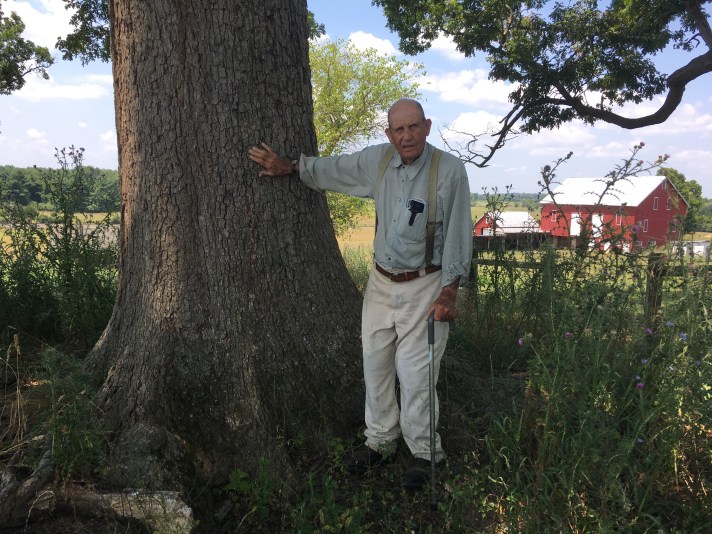
“Yes, I work all the time. But I enjoy work,” he says, and then adds with a smile, “I’ll go as long as the good Lord lets me. Have you ever seen anyone mow with a cane?”

 clarkelandconservation.org